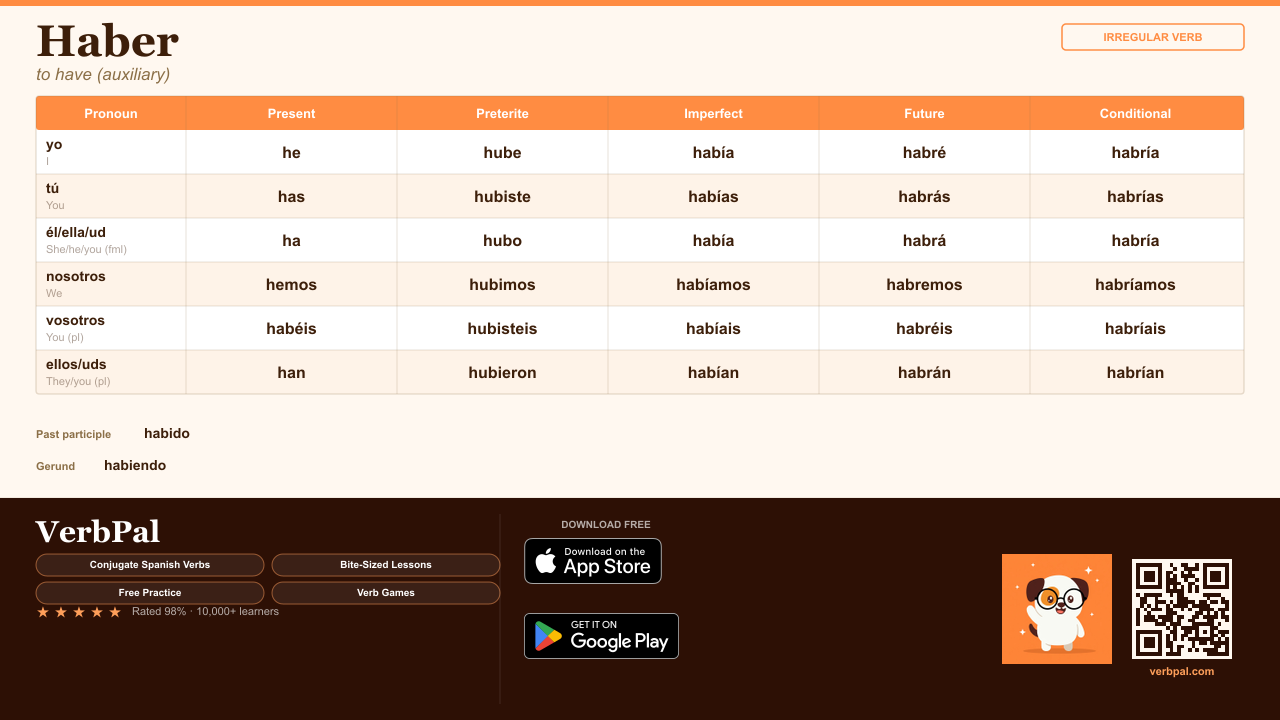
The Spanish verb "haber" means "to have (auxiliary)" in English. It is an irregular verb. Below you'll find the complete conjugation tables for "haber" across all 5 tenses.
The Spanish verb "haber" means "to have (auxiliary)" in English. It is an irregular verb. Below you'll find the complete conjugation tables for "haber" across all 5 tenses.
| Person | English | Conjugation |
|---|---|---|
| yo | I | he |
| tú | you (informal) | has |
| él/ella/usted | he/she/you (formal) | ha |
| nosotros | we | hemos |
| vosotros | you all (Spain) | habéis |
| ellos/ustedes | they/you all | han |
| Person | English | Conjugation |
|---|---|---|
| yo | I | hube |
| tú | you (informal) | hubiste |
| él/ella/usted | he/she/you (formal) | hubo |
| nosotros | we | hubimos |
| vosotros | you all (Spain) | hubisteis |
| ellos/ustedes | they/you all | hubieron |
VerbPal drills "haber" in real Spanish sentences using spaced repetition.
Try VerbPal Free| Person | English | Conjugation |
|---|---|---|
| yo | I | había |
| tú | you (informal) | habías |
| él/ella/usted | he/she/you (formal) | había |
| nosotros | we | habíamos |
| vosotros | you all (Spain) | habíais |
| ellos/ustedes | they/you all | habían |
| Person | English | Conjugation |
|---|---|---|
| yo | I | habré |
| tú | you (informal) | habrás |
| él/ella/usted | he/she/you (formal) | habrá |
| nosotros | we | habremos |
| vosotros | you all (Spain) | habréis |
| ellos/ustedes | they/you all | habrán |
| Person | English | Conjugation |
|---|---|---|
| yo | I | habría |
| tú | you (informal) | habrías |
| él/ella/usted | he/she/you (formal) | habría |
| nosotros | we | habríamos |
| vosotros | you all (Spain) | habríais |
| ellos/ustedes | they/you all | habrían |
Stop memorizing tables. Start speaking with confidence.
Try VerbPal Free7-day free trial. Cancel anytime.