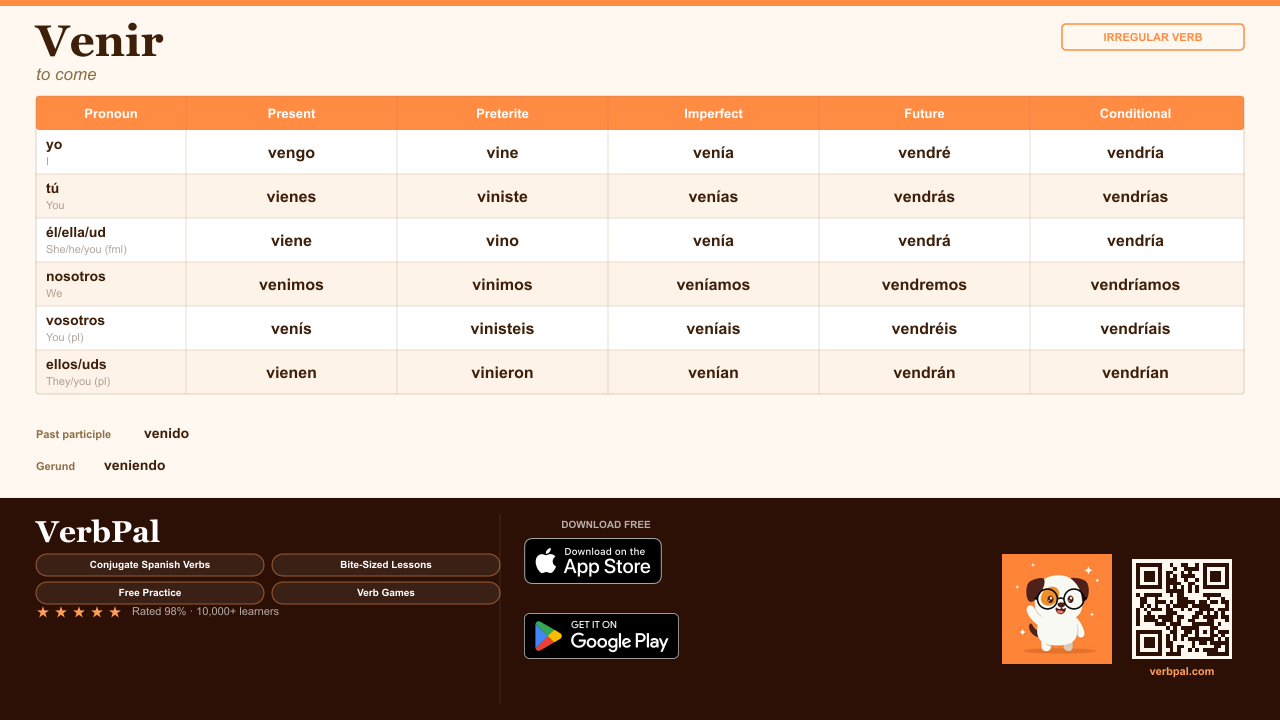
The Spanish verb "venir" means "to come" in English. It is an irregular verb. Below you'll find the complete conjugation tables for "venir" across all 5 tenses. New to Spanish verbs? Start with the Spanish verb guide.
Jump to a tense

Lexi's Memory Hack
VENIR has two quirks: yo VENGO (g inserted), and it stem-changes E → IE in the boot (vienes, viene, vienen). Think: "VENGO with the GANG, and we're COMING in with energy."
Future/conditional uses: vendr- (vendré, vendría). Command: ven (informal).
How to Conjugate "venir" in the Present Tense
Presente de indicativo Actions happening now or regularly| Person | English | Conjugation |
|---|---|---|
| yo | I | vengo |
| tú | you (informal) | vienes |
| él/ella/usted | he/she/you (formal) | viene |
| nosotros | we | venimos |
| vosotros | you all (Spain) | venís |
| ellos/ustedes | they/you all | vienen |
Ella viene a mi fiesta.
She comes to my party.
How to Conjugate "venir" in the Past (completed) Tense
Pretérito perfecto simple Actions that finished in the past| Person | English | Conjugation |
|---|---|---|
| yo | I | vine |
| tú | you (informal) | viniste |
| él/ella/usted | he/she/you (formal) | vino |
| nosotros | we | vinimos |
| vosotros | you all (Spain) | vinisteis |
| ellos/ustedes | they/you all | vinieron |
Él vino a visitarme el domingo.
He came to visit me on Sunday.
Want to actually remember these?
VerbPal drills "venir" in real Spanish sentences using spaced repetition.
Try VerbPal FreeHow to Conjugate "venir" in the Past (ongoing) Tense
Pretérito imperfecto Actions that were ongoing in the past| Person | English | Conjugation |
|---|---|---|
| yo | I | venía |
| tú | you (informal) | venías |
| él/ella/usted | he/she/you (formal) | venía |
| nosotros | we | veníamos |
| vosotros | you all (Spain) | veníais |
| ellos/ustedes | they/you all | venían |
Ella venía de la escuela.
She was coming from school.
How to Conjugate "venir" in the Future Tense
Futuro simple Actions that will happen| Person | English | Conjugation |
|---|---|---|
| yo | I | vendré |
| tú | you (informal) | vendrás |
| él/ella/usted | he/she/you (formal) | vendrá |
| nosotros | we | vendremos |
| vosotros | you all (Spain) | vendréis |
| ellos/ustedes | they/you all | vendrán |
Ella vendrá con nosotros hoy.
She will come with us today.
How to Conjugate "venir" in the Would (conditional) Tense
Condicional simple Hypothetical actions| Person | English | Conjugation |
|---|---|---|
| yo | I | vendría |
| tú | you (informal) | vendrías |
| él/ella/usted | he/she/you (formal) | vendría |
| nosotros | we | vendríamos |
| vosotros | you all (Spain) | vendríais |
| ellos/ustedes | they/you all | vendrían |
Él vendría mañana temprano.
He would come early tomorrow.
Frequently Asked Questions About "venir"
Is "venir" regular or irregular in Spanish?
"Venir" is an irregular Spanish verb, meaning its conjugation does not follow standard patterns and must be memorized individually.
What does "venir" mean in English?
The Spanish verb "venir" means "to come" in English.
How do you conjugate "venir" in the present tense?
In the present tense (Presente de indicativo): yo → vengo, tú → vienes, él/ella/usted → viene, nosotros → venimos, vosotros → venís, ellos/ustedes → vienen.
How many tenses does "venir" have in Spanish?
"Venir" is conjugated across 5 tenses in Spanish: Present, Past (completed), Past (ongoing), Future, Would (conditional).
Master Spanish verbs for real
Stop memorizing tables. Start speaking with confidence.
Try VerbPal Free3-day free trial. Cancel anytime.